 Originally Proclaimed: 04/21/19
Intro:
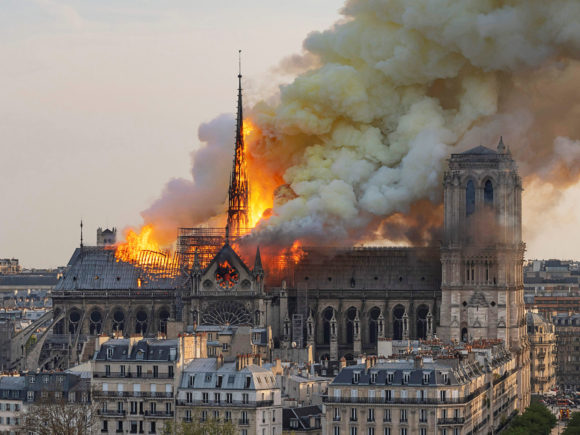
- Last Monday as the world watched, one of the most renown landmarks in Paris, France burned.
- For 12 hours the lead story and continuing coverage on news outlets focused on the inferno at Notre Dame. The roof was destroyed as well as the spire
- Before any formal investigations into the cause of the blaze commenced, already there were calls for the icon to be rebuilt.
- Within just a few days, pledges for a billion euros, equivalent to 1 billion, 125 million dollars, were received from citizens and companies all over the world.
- Even so, some say that the cost could reach 2 Billion Euros or more.
- That does not deter but only spurs on the gifts for the icon’s restoration.
- French ident Emmanuel Macron called for the rebuilding of the cathedral in five years in time for the Paris Olympics. He says that France would “convert this disaster into an opportunity”.
- Architects and engineers say the restoration may take decades.
- But again no one seems deterred but only more resolved to make the restoration happen.
- The general feeling is that “Paris needs Notre Dame,” as told by said Aime Cougoureux, the owner of a popular restaurant near the Victor Hugo museum. She says, “the tourists love it, too, especially Americans. When there are no Americans in Paris, it’s an economic crisis.”
- https://www.usatoday.com/story/news/world/2019/04/20/notre-dame-cathedral-fire-1-billion-rebuild-paris-france-church/3528844002/
Hook:
- This sentiment, to go to whatever lengths it make take to rebuild a cathedral offers us an insight into our humanity as well as a challenge to our faith.
- When people genuinely believe in a project or a cause, they will give and will work to see it accomplished no matter how daunting or challenging the circumstances.
- The challenge for our faith as we end Mark’s gospel is whether we genuinely believe in the person and work of Jesus Christ enough to give our lives and fortunes to see his gospel go to all the nations.
- I want to offer you three considerations from Mark 16 that should motivate us to go to extreme lengths to bring the gospel to others.
Message Points:
- As we come to the close of this gospel we encounter again these faithful women who were not bold and determined enough to honor Jesus that they would go to a tomb three on the third day after the death of Jesus.
- First consider the kind of ridicule at best, and outright abuse at worst these women could have faced for going to the tomb of a man who was a criminal in the eyes of Rome and heretic in the eyes of the Jewish establishment.
- While viewing a body on the third day may not sound odd to us considering that we often have a funeral roughly three days after a person has passed, but that was not the case in the ancient world. The longer one waited after death to prepare a body and have a funeral, the more likely that the corpse had begun to experience putrid decay.
- That brings up the great cost the anointing spices would have incurred for these women. While we read that these women had some means to support Jesus through his ministry, 16:1 tells us that they had to go to the market to buy spices to perfume the body. They had no reservation about spending the money to honor Christ.
- Further, to go to anoint Jesus and to touch his dead body would mean according to Numbers 19:11-13 that these women would be unclean for seven days and have a ritual purification or else be cut off from God’s people.
- And most challenging factor, they recognized on the way to the tomb, according to verse 3 that they still had to contend with the stone. https://theosophical.wordpress.com/2011/03/24/the-size-of-the-stone-covering-jesus%E2%80%99-tomb-2/
- The stone would have been in a groove cut into the rock just in front of the rock face.
- Even if this were the smallest of stones, it would be four to six feet in diameter and about 1 foot thick. The weight of such a stone would be between one to two tons.
- Because of the slope downward into the groove, the stone would more easily roll into place, so that two men could easily perform this task.
- But to roll the stone away, the stone would have to be pushed upward, out of the groove, and would have required more force with perhaps an additional person to help.
- The reason I am going to these lengths is to assure you that these were not just overly emotional women who had no resolve or ability to endure challenges.
- In going to the tomb that day they accepted all of the difficulties and the challenges in choosing to honor Jesus. These ladies had prepared themselves for all the challenges of honoring a dead prophet.
- But what we do need to consider is that honoring a dead prophet does not involve the same kind of commitment that honoring a risen Savior and Lord requires.
- To honor a dead prophet, it is the choice of the living to offer any tributes and the decision of those who remain as to what is too costly.
- On the other hand, a risen Savior and Lord, powerful enough to rise from the grave, may ask or command anything of us.
- That is the challenge faced by the first century women.
- This leads to our 1st consideration this morning: Going to the Tomb, do we SEEK a dead prophet or a risen Savior and LORD. (16:1-8)
- Notice with me first that these women in verse 5 are alarmed that Jesus’ body is missing and this young man in white now sits in the tomb as a messenger.
- The young man tells them that He is risen, and invites them to inspect the place where he laid in verse six. This should not have been a surprise since Jesus predicted his resurrection three times (Mark 8:31, 9:31, and 10:33-34)
- Then the young man gives them instructions about heading to the Galilee that echoes Jesus’ own words in 14:28.
- After hearing these words the women were trembling and bewildered, fleeing the tomb afraid to tell anyone.
- These women were not prepared to see a risen Savior and Lord as verse eight relates to us.
- The words trembling and bewilderment occur in Mark only twice, but the word afraid in this sense occurs twelve times, ten of which are negative (Pillar Commentary, 496-497)
- Trembling relates the women’s physical reaction to the new of Jesus’ resurrection.
- The word amazement is one that relates to us both their great excitement, but also their uneasy fear. It is the kind of feeling that we might feel in the moments on a roller coaster just before we go over the edge hurtling downward towards the upside down loops and corkscrew. These women were caught up in the moment.
- The word afraid is common enough to us, and has been seen in this gospel a number of times. Literally they point to the sort of apprehensiveness and fearfulness that occurs when someone does not know how to rightly respond to an experience. It is the kind of fear that builds when you think someone is following you, because you do not know how to best respond to the situation. It is the kind of terror combatants face in the fog of war, having to react rather than reason out a situation.
- And friends that is the consideration that we should be faced with this morning.
- If we are okay with honoring a dead prophet are we really ready to honor a risen Lord.
- Jesus is calling to us all today. He asks that we follow him, give him our lives, go to the places he commands us and share the gospel of his resurrection!
- He is risen friends, and risen indeed.
- Just think of the sort of apprehension we have felt as you wait in line for a roller coaster. Or the kind of trembling we may have faced as we prepared to walk down the aisle and marry our spouses. Or for those of us who have faced the most tremendous of fearful situations like military combat, the kind of anxiety that might be felt before a battle.
- None of these situations can compare with the magnitude and eternal significance of our decision to go to the extreme lengths that a risen Savior might call us. And yet call us he does, so consider that.
- But also consider the extreme rewards and blessing of pleasing a risen Savior. One who has the power to raise from the dead also has the power to grant to us every blessing of Heaven for all of eternity.
- Notice with me first that these women in verse 5 are alarmed that Jesus’ body is missing and this young man in white now sits in the tomb as a messenger.
- Some believe this is the place where Mark’s gospel ends, but in the original language, the final word is a conjunction.
- This is an odd construction, rarely if ever used in the rest of Greek literature, and almost guaranteeing that there is more to Mark’s gospel that verse eight.
- That said, the last eleven verses in most of our Bibles are certainly a later addition to the original text.
- They form a sort of postscript, but a very early post script.
- While not all copies of Mark have the ending, copies with the longer ending were well known and referenced by church leaders in the second century including Tatian, Justin Martyr and Irenaeus.
- Personally, I follow the theories of David Alan Black concerning the composition of Mark and especially the longer ending, attributing it at a later date to the evangelist Mark himself (Why Four Gospels).
- First, following the Griesbach theory, Black believes Mark was written as the third gospel as a record of Peter’s preaching. Its purpose was to bridge the gap between Matthew (written 1st as the gospel to the Jews) and Luke (written 2nd as a record of Paul’s gospel to the gentiles).
- Thus Mark accompanied Peter to Rome, but was quickly forced to leave as persecution broke out, perhaps at the arrest of Peter. This persecution eventually led to Peter and Paul’s matrydom; and any Christians not wanting to be swept up in Nero’s mad rage would have been forced to depart the city hastily.
- Copies with the shorter ending of Mark began to circulated either damaged in the persecution or unfinished as Mark had to leave Rome quickly. But espeically with the matrydom of Peter,
- Church tradition tells us that Mark fled to Alexandria, Egypt and it is well known that he ministered there until his own death.
- Black believes that Mark penned this postscript to his gospel once he was settled and able to complete the work he had begun. This explains why copies with the longer ending then began to circulate near the end of the 1st Century alongside of those copies with the shorter ending.
- Thus, while I believe we should not focus all of our attention upon these verse of the longer ending, I do believe we should consider these verses as we do any difficult passage in Scripture.
- Most importantly, for a gospel that begins on the go, telling us in 1:1 that it will relate the beginning of the good news about Jesus the Messiah, the Son of God” these verses serve as a fitting end, telling us that the disciples did not remain in their fear, but began to go everywhere to preach the gospel and the Lord Jesus continued to work through them.
- This leads us to our 2nd Consideration: Getting Past Our Fears means that we SERVE the risen Lord because He is the most important person in our lives. (16:9-14)
- These next verses relate three appearances of the risen Jesus to his disciples.
- The subject has changed appropriately from the women seeking Jesus to the risen Lord.
- This change in the point of view tells us that Jesus was not willing that his disciples would continue in fear. He begins to appear to them to bolster their weak faith.
- First he appears to Mary Magdalene.
- She was one of the women in the first eight verses.
- After Jesus appears to her she goes to tell the others who were still mourning and weeping.
- The rest did not believe, but Mary obviously did. Her personal relationship with Jesus confirmed in that appearance is why she began to share the gospel of Jesus’ resurrection.
- Second we see that Jesus appears to two unnamed disciples while they walked in the country.
- Again they return to tell the others, but the others do not believe.
- These two though had been transformed by their personal relationship with the risen Lord.
- Finally, we see that Jesus appears to the Eleven, and personally deals with their lack of faith.
- Now Jesus’ personal relationship with the Eleven confirmed in his appearance to them changes them.
- And notice that it is the preaching of the gospel that Jesus uses to break down their hardness of heart and lack of faith.
- These Eleven had heard the witness of Mary. They had heard the witness of the two from the country, and now it was the witness of Jesus Himself that transforms them.
- And friends is that not the same with us?
- We may hear preaching about Jesus all of our lives, but it is when Jesus personally begins to call for us to believe that we respond.
- Though we may not see the resurrected Lord, we cannot deny the power of His resurrection when in our minds and spirits we begin to hear Him call to us.
- I have told you before about my own conversion.
- I had been to church all my life.
- I had heard the gospel proclaimed and could even tell you the story myself.
- But until that day when I finally felt the weight of my sin and heard the Savior calling to me in my spirit I did not understand how I could follow a Savior I did not see.
- Once He did call me and redeem me, I knew that I would follow Him because Jesus was now the most important relationship in my life.
- So consider today, Is Jesus the most person in your life?
- These next verses relate three appearances of the risen Jesus to his disciples.
- Finally we see our 3rd consideration: So Get Going to SHARE the gospel of our risen Lord. (Mark 16:15-20)
- Jesus now commands his disciples, giving them a great commission, as any Lord would do for his subjects in verses 15-16
- He tells them to preach the gospel to all creation.
- Here that word means to preach not to every rock and animal, but to preach in every place where there are people.
- The gospel is for all, not just for the few, select people.
- Jesus also tells the disciples that some will believe, be baptized as those were today into the family of faith, symbolizing their salvation.
- Jesus also tells the disciples that some would not believe and face their eternal consequences.
- The same gospel that softens the hearts of some by the Spirit of God will harden the hearts of others.
- He tells them to preach the gospel to all creation.
- Then we read of some miraculous signs in Mark 16:17-18 that would accompany his apostles and those who believe them as they proclaim the gospel.
- The use of the word signs is nothing new, as many demanded a sign from Jesus.
- Such works authenticated the message that one preached.
- The fact that they do these things “in my name” attests to the fact that these apostles have a delegated authority intended to authenticate the message they preached.
- These signs are:
- Driving out demons
- Speaking in Tongues
- Picking up snakes
- Drink deadly poison
- Heal the sick
- In fact the believers are recorded as fulfilling all these in the NT except drinking deadly poison.
- The disciples on their mission from Jesus in chapter 6:13 had driven out demons already and healed sick people even as they preached the gospel.
- Acts 2 and then 1 Cor. 12 and 14 describe the way that the early believers in Jesus spoke in tongues, so that the gospel could spread.
- Acts 28:3 relates to us how Paul on his journey to Rome was bitten by a viper and lived, giving him the opportunity to preach the gospel to people of Malta and heal Publius their governor.
- Even the drinking of deadly poison though not recorded in Scripture is said in church tradition to have been accomplished by the apostle John, and not surprising if God could work to quell the venom of a viper with Paul.
- In all these cases the disciples used these miracles to further SHARE their message about Jesus.
- Thus, these verses teach us that the authority and power of Jesus will be at work among us even in this day.
- While we may not see all of the same types of miracles today,
- How can we not ignore when Jesus chooses to make a long-shot treatment of a patient effective?
- How can we not ignore a gift that shows up at just the right time to meet a real need?
- How can we not ignore a perfectly timed phone call or visit with someone for whom we have been praying?
- How can we ignore Jesus’ work in our lives?
- Anytime we see Jesus at work in our lives we should use it as an opportunity to preach the gospel of our risen Lord.
- The use of the word signs is nothing new, as many demanded a sign from Jesus.
- Notice if you will verse 19-20. There we find the first reference in Mark’s gospel to Jesus as “the Lord”.
- This is the title utilized by Jews to describe their relationship to the one true God.
- It is highly fitting for Jesus to be called Lord since we read that he ascended in verse 19 and sat at the right hand of God.
- And it is no wonder that Mark waits to call him Lord until here, once Jesus has been proven to be the Messiah and the son of God.
- An notice the believers preach everywhere, but it is the Lord who works with them and confirms their preaching.
- Though Jesus is the risen Lord, He is not a distant, unrelatable Lord. Jesus is still working with His followers and confirming His Word with them.
- But that is what we must consider. Will we SHARE Jesus as our Lord.
- Jesus now commands his disciples, giving them a great commission, as any Lord would do for his subjects in verses 15-16
Conclusion:
- The commitment of people to resurrect a cathedral from the ashes in Paris should challenge every one of us who believe in Jesus Christ as Lord.
- If people are willing to give their money, their labors, and their all for a building; how must more should we be willing to go to any extreme that our risen Lord might call us to accomplish?
- Will we depart today in fear or will we turn and follow Jesus as our Savior and Lord?
 Let the Shepherd Lead
Leave a comment