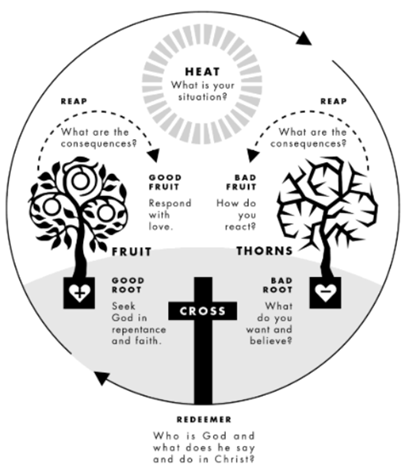
- Before we can help people with their problems, we must understand their problematic situations.
- To do this, it is helpful for us to consider how we can analyze their problems and situations biblically.
- Jeremiah 17:5-13 gives us a good guide to begin understanding the differing dimensions of a problem situation.
- Before we begin to examine these verses take a look at verse 17:1.
- We read that “the sin of Judah is written with a pen of iron; with a point of diamond it is engraved on the tablet of their heart”.
- If Judah’s sin was so written, how different will the sins of those we help be written?
- The iron pen with a diamond tip indicate that even for the most religious, sin is engraved much more permanently into the fabric of our existence than we would realize.
- For this matter, as biblical shepherds, we will need to gather as much information as possible about the problems and situations of those we help.
- Jeremiah 17:5-13 gives us a simple framework by which we can organize this information.
- Let’s briefly outline the passage before we begin to pull out the framework that will help us analyze our information.
- Verses 17:5-6 – The person whose heart trusts in man rather than the Lord is like a shrub in the parched desert.
- Verses 17:7-8 – The person whose heart trust in the Lord is like a tree planted by a stream, never withering and always bearing fruit.
- Verses 17:9-10 – Only the Lord can search and judge our deceitful, sick, and wicked hearts.
- Verses 17:11-13 – In the end, those who forsake the Lord will be shamed, precisely because they could not survive without His Living Water.
- This brief outline helps us to see that every problem situation has six major components to consider: The Root, The Tree, The Environment, The Fruit, The Harvest, The Cross.
- We will consider the first of these in this post and the others in coming posts.
- So let’s begin with “The Root”. The root is our heart’s posture towards God in the situations we face.
- Notice in verse 5 and verse 7 the root issue is the question “Who will I trust?”.
- Our heart will respond very differently depending on whether we trust only our self, or certain others, or God alone.
- As shepherds we want to focus on how each person may or may not be trusting in God and His Word in their unique situation.
- But we must also realize that this root issue is often not something that we will see at first or even discern correctly until we have done some digging.
- Verses 7-8 refer to the deceitful and sick nature of the heart.
- When someone comes to us for help they often will not recognize how much their trust in God or rejection of God affects every part of their lives.
- Further, the Lord promises to search each heart.
- He knows just how sick and twisted our hearts actually are, and promises to give us what our heart responses deserve.
- As shepherds we have the biblical responsibility to gather enough information about each person’s problems and situations to know their inward posture towards God.
- We also must warn them about their accountability supremely to the God who knows their heart’s posture.
- Notice in verse 5 and verse 7 the root issue is the question “Who will I trust?”.
 Let the Shepherd Lead
Leave a comment