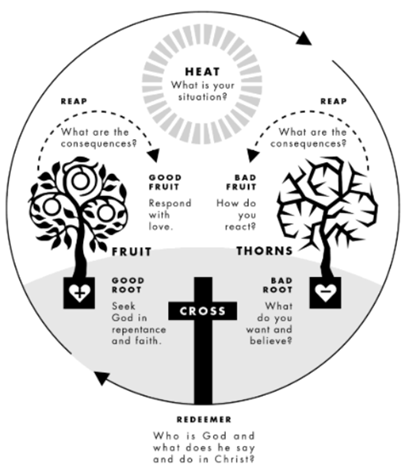
- From the prior section, we agreed that Jeremiah 17 teaches us that every problem has a root issue in the heart or inward posture of a person towards God.
- Thus every problem at its core is a spiritual problem.
- Further, for shepherds, the goal must always be treating the root problem, not symptoms that a person might present to us first.
- Rarely do people come to us for help with a firm understanding of their root problem.
- Often the opposite is true, where a person comes for help due to a complicating problem or a resulting consequence that they can no longer endure.
- In the way Jeremiah speaks, people notice that their tree is not producing the fruit they desire.
- Look again at verse 17:6. In the text, the person who trusts in flesh is like a bush, without prosperity and without any benefits.
- Conversely the person who trusts in the Lord in verses 17:7-8 is like a tree with deep roots, staying green and bearing fruit.
- When we begin to help someone, we must recognize that the problems they share are real and serious, but not the root issue.
- They will often first bring us the fruit of their lives to examine.
- Asking good questions and gathering good information allows us to find out the type of fruit in that person’s life. Here are some examples of negative fruit from the text that Tripp and Lane call thorns.
- Physical weariness or spiritual dryness (17:6).
- A lack of prosperity or perspective on their situation (17:6).
- A lack of real relationships (17:6).
- Tremendous effort towards fleeting wealth, prestige or possessions (17:11).
- A sense of shame (17:13)
- A sense of worthlessness (17:13 “written in the dust”).
- Contrast those negative fruits with the positive ones.
- Deep roots that can find spiritual refreshment (17:8 & 17:13 “spring of living water”)
- Proper perspective on circumstances (17:8 “heat” “drought”)
- Fruitfulness in all seasons (17:8)
- Asking good questions and gathering good information allows us to find out the type of fruit in that person’s life. Here are some examples of negative fruit from the text that Tripp and Lane call thorns.
- As biblical counselors, when we see their fruit, we must remember, fruit does not come from a vacuum.
- The type of fruit a person produces comes directly from the type of “tree” a person is (see Matt. 7:15-20; Luke 6:43-45).
- Jeremiah and Jesus use the example of the tree because it easily demonstrates the connection between the root to the fruit.
- The tree is a symbol of the response of those we help to the God who allows or ordains certain circumstances in their lives.
- A person’s heart responses bear out theIr inward disposition towards God, either positive or negative.
- Naturally the a persons attitudes, beliefs, and habits lead to the fruit their lives produce.
- This explains the reason for the popularity of cognitive behavioral therapy (CBT) in the world.
- Without referencing the spiritual realities we acknowledge, CBT sees the connection between thinking, action, and results.
- Thus it seeks to change thinking first in order to achieve different actions and then results.
- Psychology stumbled onto the realities that pastors and believers have known for generations – “Change the heart and change the person.”
- Thus as we begin to examine the fruit, we should be asking questions that lead everyone to recognize the way our responses to circumstances and relationships, connect our inward disposition toward God with the fruit our lives.
- Early in counseling we must avoid the temptation to focus entirely on circumstances or even the inevitable complicating problems; and instead focus on how someone came to produce a certain type of fruit in their lives.
- The type of fruit a person produces comes directly from the type of “tree” a person is (see Matt. 7:15-20; Luke 6:43-45).
 Let the Shepherd Lead
Leave a comment