Originally Proclaimed: November 28, 2021 – Hanging of the Green Service
Intro:
- How often do we find a treasure?
- Recently I was reading the Union newspaper which gave the account of a missing Bible that was returned to a gentleman after forty years.
- The Bible had been at the man’s childhood home until a fire which left most of the home’s contents unusable.
- Placed in a box with other “salvageable” goods it eventually found its way into a yard sale, and was purchased by someone who was looking for a treasure.
- The buyer sorting through the items discovered a small card in the Bible with the man’s name address and other information.
- As it turns out the Bible had been used on a mission trip a number of years earlier and was specially marked to share the gospel with others.

- Had it not been for a similar situation in 1851 we likely would not have the Hymn “O Come; O Come Emmanuel”.
- In a library tucked away were the Latin words to this wonderful hymn.
- The original antiphons or anthems were composed during the 800s to be sung in Catholic evening worship services leading up to Christmas.
- But England from the time of Henry VIII onward was an increasingly Protestant nation.
- The old Catholic ways, both good and bad were swept out in favor of the English Reformation.
- By the 1850s some of those former practices and traditions were being rediscovered and repackaged for the Protestant church.
- Into this climate, John Mason Neale began his service as a pastor.
- Caring, compassionate, but quite bookish; Neale was assigned a post in the Anglican church at Sackville College.
- Don’t be fooled. This was not an institute of higher learning, but a retirement and nursing home.
- This suited Neale well as he could pastorally care for the aging, while spending his time digging into the library to discover treasures of the past.
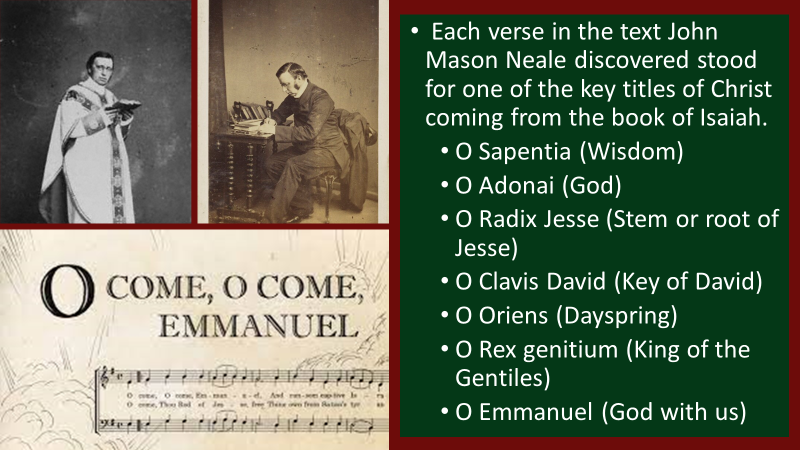
- Discovering the Latin texts Neale set out to translate and set them to appropriate tunes.
- Along with others like “Good King Wenceslas”, “Good Christian Men Rejoice”, and “All Glory, Laud, and Honor”; “O Come; O Come Emmanuel” became one of the most popular of his works.
- It stands as one of the few hymns we have that communicates the longing expectation of advent – both for the first and second coming of Christ.
- For Neale this Latin text was so attractive because of its deep meaning.
- Primarily the original text formed an acrostic with the letters SARCORE.
- Each verse stood for one of the key titles of Christ coming from the book of Isaiah.
- O Sapentia (Wisdom)
- O Adonai (God)
- O Radix Jesse (Stem or root of Jesse)
- O Clavis David (Key of David)
- O Oriens (Dayspring)
- O Rex genitium (King of the Gentiles)
- O Emmanuel (God with us)
- This means nothing in Latin, but if it were reversed the phrase Ero Cras emerges.
- That phrase means “Tomorrow I will come” referring of course to Christ.
- The final of these verses would be sung the night before Christmas, and of course tomorrow Christ would come.
- The beautiful text along with surprise impact of Christ’s coming lead Neal to translate the text.
- He also paired it with a haunting minor key verse only to be overcome by the joyous major key chorus meant to inspire us to Rejoice.
- While others honed and refined the text and the tune, the hymn stands today as a testament to this man’s willingness to search for the treasures tucked away in hidden corners.
Hook:
- So again, how often do we discover a treasure?
- I want to suggest to us today as we begin this message in our Hymns of the Holidays that we could discover treasures more than we do.
- The issue is whether or not we are willing to do the work of searching, and longing, and expecting to find something that is truly life changing.
- So maybe we should ask, How often do we seek treausre?
- This is Isaiah’s message to us in chapter 7 of his prophecy. There he begs us to discover that we have a Lord who will come and save us.
Message Points:
- As we get into this message you might be wondering why we turn to the Old Testament book of Isaiah.
- As a prophet, Isaiah writes more about the gospel than any of his contemporaries.
- In fact, he lays out the basics of what it means for God to send a Messiah-King to save us especially in these chapters 7-9 and later in those chapters surrounding 53.
- In fact Isaiah 7:14 is quoted in the first chapter of Matthew as referring to both Isaiah’s day and to Christ.
- This brings us to an important point about Hebrew prophecy.
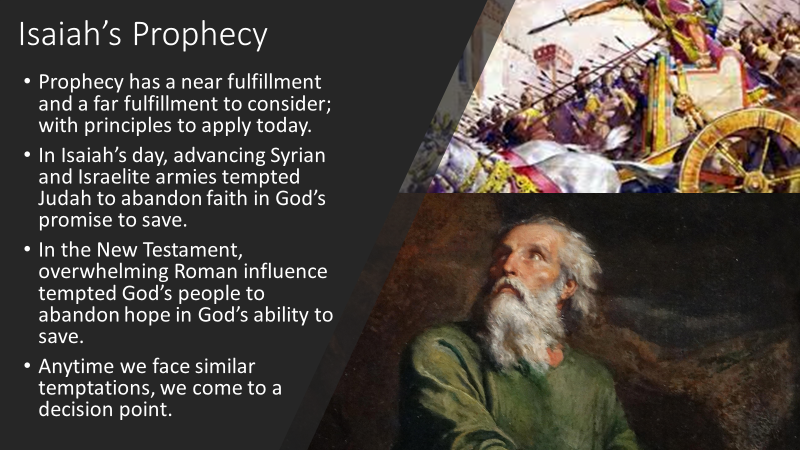
- Prophecy has a near fulfillment and a far fulfillment to consider; with principles to apply today.
- In Isaiah’s day, advancing Syrian and Israelite armies tempted Judah to abandon faith in God’s promise to save.
- In the New Testament, overwhelming Roman influence tempted God’s people to abandon hope in God’s ability to save.
- Anytime we face similar temptations, we come to a decision point.
- Will we choose to search, seek, and discover the treasures of our Savior?
- Or will we shrink back into the ease or distress of our lives?
- Isaiah challenges us today with his prophecy drawing us to three questions.
- The first of these questions comes amid Isaiah’s challenge to the King of Judah in his day to ask for a sign from God.
- But friends don’t mistake it, God was the one who offered to show Ahaz a sign.
- In a seemingly pious and religious statement King Ahaz says, I will not ask; I will not test the Lord.”
- But remember God asked Ahaz to ask for a sign. To not ask for a sign was testing the Lord.
- This phrase “test the Lord” as one commentator says, “demonstrated himself to be an unbelieving man.” (Moytner, 83)
- So friends Isaiah confronts us with the same question, 1) “Will we ask for the Lord’s help? (10-12)”
- The first of these questions comes amid Isaiah’s challenge to the King of Judah in his day to ask for a sign from God.
- We all feel the effects of inflation.
- Despite the contrived togetherness of gathering each weekend during a football season; none of us escape the real divides politically, racially, and socially in our country.
- We each have our own personal pain, grief, and struggles.
- This was true for King Ahaz as the Syro-Isralite alliance threatened attack.
- It was true for the people of Judah around the time of the New Testament when Rome increasingly controlled every aspect of their lives.
- In the face of those circumstances, will we choose to ask the Lord for help to search and find out how he will save us?
- Some will reject the Lord’s help outright because they believe they can do things on their own.
- Others might be like Ahaz and politely, piously decline his help.
- But here is the real treasure Isaiah wants us to find, Asking for the Lord’s help is not a sign of weakness but of hope.
- So as we continue to read Isaiah’s text he now turns to challenge King Ahaz for his unbelief.
- Polite, pious answers were not going to cut it.
- Notice how Isaiah says, “is it not enough for you to try the patience of men? Will you also try the patience of my God?”
- Isaiah is telling us that people disappoint us.
- With each of the verses of “O come; O come Emmanuel” we hear this sort of discord and disappointment over people.
- Captive Israel must be ransomed from lonely exile in verse 1.
- Verse 2 communicates to us the disappointing fact that people do not naturally have wisdom or knowledge and need that from the Lord.
- Verse 3 tells us that every nation has a desire and we can easily turn towards strife.
- Verse 4 similarly tells us that we have gloomy spirits that are haunted by deaths dark shadows.
- By confessing his frustration and disappointment with King Ahaz, Isaiah is reminding us that disappointment is a part of life.
- Yet, as we read onwards we hear Isaiah’s second question 2) Will we have faith in God’s promises? (13-15)

- Notice verse fourteen, which is the one quoted in the NT.
- It tells us that the Lord will give us a sign, not that people can be trusted, but that He can be trusted.
- The Lord’s promise is bound up in the beautiful blessing of new life.
- Friends, its hard not to have hope when we hold a new born baby.
- Every time I held one of my own children, I could not escape the palatable sense of hope that God would do something great with this child.
- So God promised to give a child whose title is Immanuel which means “God with Us”.
- In Isaiah’s day this was one of his own children born out of his recent marriage to a virgin girl. This child grew up in the presence of King Ahaz.
- In the NT they look at the circumstances of Jesus’ birth and again see how God gave a sign.
- Lest we think this child will be so high and mighty and privileged that we cannot relate, we are told that the child will be eating curds and honey.
- The phrase “land flowing with milk and honey” is a description of just how bountiful the promised land would be in the Bible.
- Because of the abundance of these things in the promised land, curds and honey became the simple meal of those in poverty or given to those who were the least in a household, namely children.
- There is something special about giving to children at Christmas that reminds us of a deeper truth about ourselves.
- See friends, disappointment may be what we find in this world, but God promises to not only give us hope but purpose.
- Giving to children at Christmas is a reminder of that purpose.
- We were made to glorify and enjoy God.
- When we give to others, and enjoy the results we tap into the real treasure for a moment.
- Likely to give requires a sacrifice on our part, but we trust God’s promise that “it is better to give than to receive”.
- When we have Faith in God’s promises allows us to notice His faithful presence.
- Take some time and read back over the verses to “O Come” and see how each verse affirms our faith in God’s presence with us.
- He is the one who will Ransom Israel.
- He is the one who authors and orders all Wisdom.
- He is the one who meets every desire and delivers us.
- He is the one who cheers us up and gives us joy.
- The final verses of Isaiah’s prophecy again present us with the fundamental question, 3)Will we long for the Savior’s advent in our lives? (16-17 see also 9b).
- Isaiah seems to be repeating an idea he first mentions in 9b “if you do not stand firm in your faith, then you will not stand at all.”
- He wants King Ahaz and us to realize that God will keep his promises in 16-17.
- Before the baby of 7:14 would be old enough to make wise decisions the Syro-Israelite alliance would crumble.
- Before Jesus would be a teen, Herod and the entire leadership of Rome over Judah would shift.
- And for us, from one Christmas season to the next God can bring overwhelming changes.
- Even as verse 16 promises the threat will be gone, verse 17 tells us that Judah will be one day closer to judgment.
- In Isaiah’s day that meant the nation of Assyria.
- In Jesus’ day that of course meant the reassertion of Roman power in the Jewish Wars that led to the destruction of Jerusalem.
- And for us, we are all one day closer to the Messiah’s second advent.
- There are some who ask me every year why we celebrate advent if Jesus has already come.
- Here is the answer friends. Jesus is coming again, and even now we should long for his appearing just as they did in the OT.
- Here is Isaiah’s point – the great treasure is in longing for the true Savior.
- If we do not long for the Savior’s advent, we will serve lessor things.
- Ahaz chose to serve his pride and fears, but eventually served the nations surrounding Judah.
- The Pharisees, Saducees, zealots, and other Jews were not searching for a Messiah. Each served their own interest until Judah and Jerusalem were no more.
- Friends if we serve ourselves we will find ourselves trapped in our disappointment and anxieties.
- He wants King Ahaz and us to realize that God will keep his promises in 16-17.
Conclusion:
- So friends, Do we rejoice at the treasure God has already given to us?
- It will take a decision to look for the Lord’s help, His presence, and His advent.
- And here is the great truth of Scripture – If we seek the Lord, we will find him (Jer. 29:13).
- Maybe we all need to pray a prayer something like this:
- Lord, I admit that I have politely and piously refused to seek you. I have chosen to be disappointed and discouraged rather than trust your promises. I have forgotten you.
- But Lord, I believe you desire for me to trust in You. You came in your first advent to prove to me that you can be trusted and present in my life. You can forgive me, cleanse me and help me live expectantly for you.
- So Lord, I confess even now that I need you in my life and long for your 2nd coming.
 Let the Shepherd Lead
Leave a comment